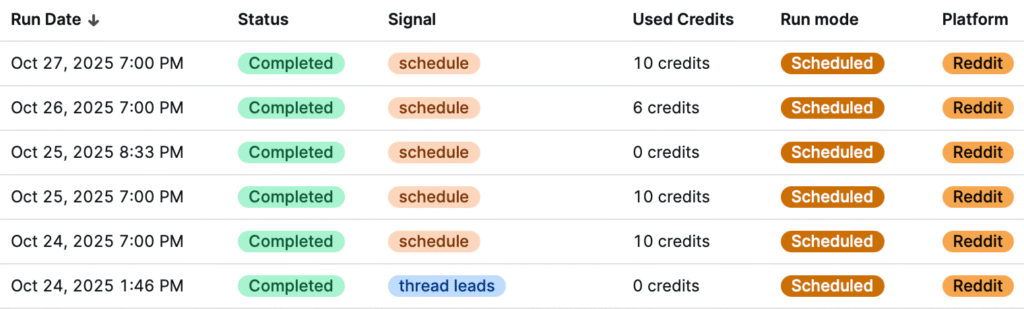
Each column in your Run History provides important details about how your Signals are performing. Understanding what each one represents helps you monitor credit usage, confirm successful runs, and identify when adjustments may be needed.
Run Columns Explained
1. Run Date
Shows the exact date and time a Signal was executed. Runs are listed in chronological order by default, but you can click the header to sort by newest or oldest first.
2. Status
Indicates whether the run was Completed or Failed:
Completed – The Signal ran successfully and retrieved posts.
Failed – The run didn’t complete, often due to insufficient credits or a temporary connection issue.
If a scheduled Signal fails due to credits, it will automatically retry once credits become available.
3. Signal
Displays the name of the Signal that was executed. This helps you trace which Signal produced specific runs—especially helpful when managing multiple campaigns or audiences.
4. Used Credits
Shows the number of credits consumed during that run. Credits are only used when posts are actually retrieved, so if your Signal didn’t find as many as expected, it will only use the number of credits equal to the posts found (no wasted credits).
5. Run Mode
Indicates how the Signal was executed:
Manual – You manually ran the Signal yourself.
Scheduled – The Signal ran automatically based on your defined 24-hour schedule (PST).
This distinction helps you track which Signals are being managed hands-on versus automatically.
6. Platform
Displays the platform the Signal was listening to during the run. Currently, all runs show Reddit, but more platforms will appear here as ThreadSignals expands support to additional sources like Quora.
Pro Tip
If you see multiple failed runs or low post counts in a row, check your credit balance and consider refining your Signal’s keywords or adding new groups to improve performance.